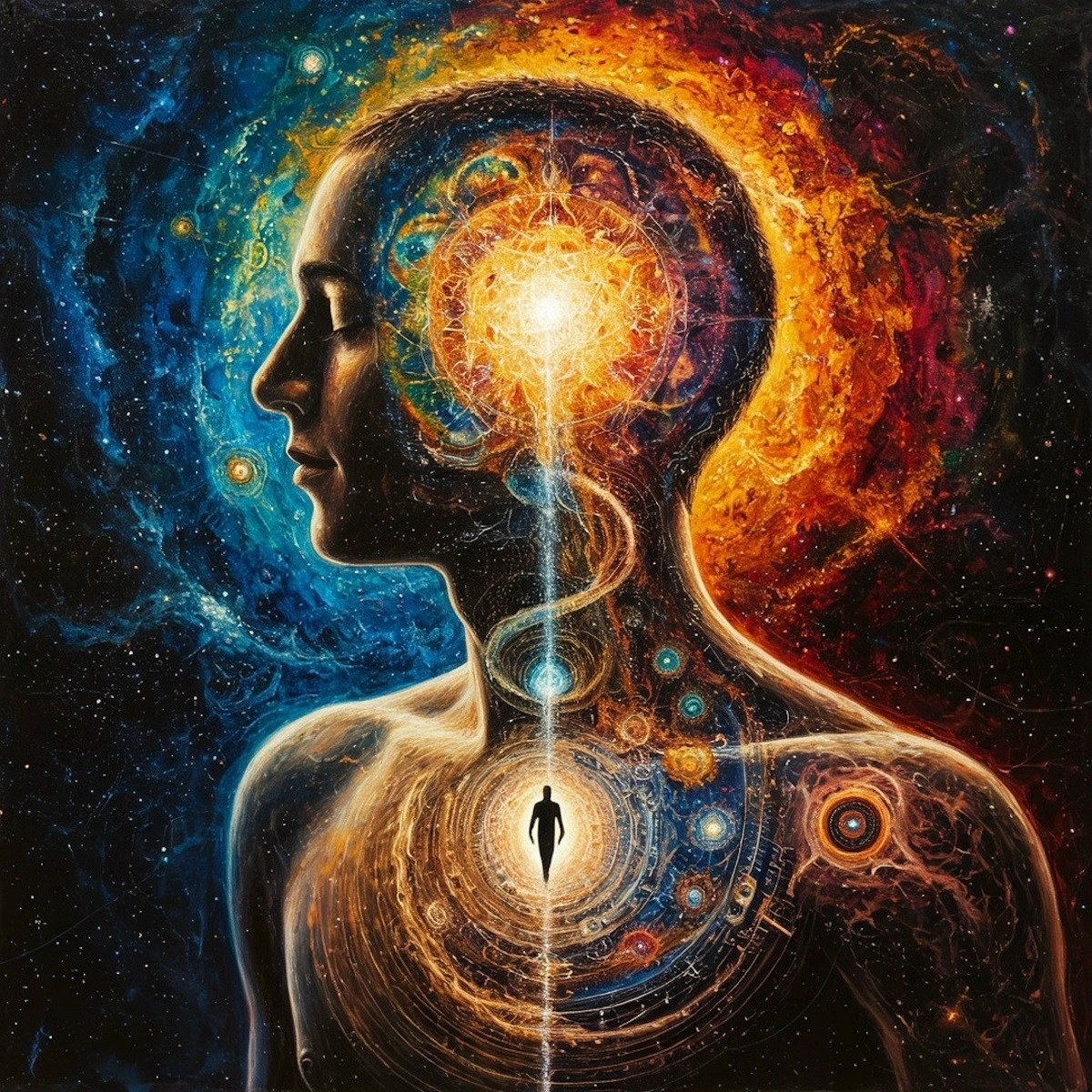
The Quest for Existence
I wanted to write an article about human existence and incarnation. This, despite the fact that I have no idea what existence is, and only a faint intuition of what incarnation might be. Well… at the very least, I can draw your attention — and my own — to this question. Shall we explore it together?
It’s just that the exploring will take a long time :):):) I’m afraid it will take an entire lifetime. You can probably figure out what and how things work sooner than that. But I’m proposing we explore — which means testing it through personal experience, i.e., actually gaining that experience and making sense of it. In this article, I’ll share the little nuggets I have.
Arriving at this state of existence won’t happen overnight. Those who have reached it — him or her — left this life early, because they fulfilled the task of their incarnation. The thing is, when a person comes to their essence, to their true existence, they begin to live life to the fullest, exactly as was intended before their incarnation. The stream of incarnation runs at full power. And by their early thirties, their purpose is already fulfilled. After that, you can keep living, if you approach it consciously — but who has ever approached it consciously? After that, you either need to start generating and reproducing yourself, simply find a meaning — or better yet, invent a task for your existence here and now, and start bringing it to life. The second option is to ask the higher powers for a new karmic — or perhaps it’s more accurate to say dharmic — task.
By the way, when it comes to existence, what matters is not what you do in this life, but how you do it. You don’t have to be Jesus Christ, Pushkin, or Lermontov, or anyone else famous and outstanding — though, I suppose, people who realize their true selves or the true meaning of their being here are few, and they become like lightbulbs in a dark stairwell, like stars in the night sky — noticeable, visible, and simply necessary, to make life just a little bit better and brighter for others.
Let’s talk about us — about the majority. I am part of the majority. And I speak for myself, as a person who still doesn’t fully know who he is, what he is, or what he is for.
Be prepared: the journey to your true self will apparently take your whole life. Beginning to embody yourself, though, will become possible somewhere after forty — provided you’ve been searching for yourself your whole life. What matters here is even the intention alone, living with this thought. In a sense, you need to become a warrior. A warrior in the sense of your own unconquerability. If you can’t walk toward your goal — look in that direction. If you can’t look — think in that direction, and reality will eventually open up. The mind shapes our reality — the question is always whose mind is shaping your reality. The mind, in this matter, is a sword. A sword must be kept clean, or it will rust. It must always be sharp, and you must constantly refine your skill in wielding it.
The first part of life is life for others, under the influence of others. This is life for civilization. It’s the paying off of karmic debts. In this part, a person needs to invest themselves in civilization — it doesn’t matter who they are: a bricklayer, a sanitation worker (what would people do without them???), a hairdresser, or a president. You first need to allow yourself to be consumed — whether by money, knowledge, religion, or a healthy lifestyle. There will be no shortage of neuroses here. Sooner or later, the understanding comes that it’s more profitable, more effective, to be useful — and that’s when work fanaticism begins. Labor doesn’t go unrewarded. The gratitude of people and the world for a person’s labor is immense. As you treat the world, so the world treats you. Sooner or later, something clicks. People will value and respect you more than before, and in return, they won’t demand as much labor from you. The person seems to become freer. That’s the impression at first. The thing is, through labor and hardship — even if you’re being thoroughly exploited in every possible way — you still develop skills, abilities; the formation and growth of your personality, your individuality takes place, a real tempering occurs. If a person gives up and loses at this stage, what follows is simply aging…
So my opinion at this stage is: fight where you can, fight where you can’t… Hone your mind.
In the first stage of life — life before forty — a person depends more on the external and lives by the external. And it’s simple here… Whoever pays calls the tune. In the first stage, internal sources don’t work yet; a person feeds from external ones. The internal sources need to be cleared — you have to reach them first. And that very stream of incarnation needs to be purified, and so on and so forth.
Erich Fromm introduced two concepts of freedom:
Negative freedom — the initial, most basic level of freedom: liberation from external constraints — prejudices, parental control, imposed rules.
Positive freedom — the highest level of freedom: the ability to realize your personality on your own. This is the freedom to create, to love, to think independently, to be spontaneous, and to make conscious decisions based on your true needs — not on someone else’s opinion or anxiety.
Until forty, a person searching for themselves will have to liberate and follow the negative path. This is the path of the rebel. There’s also the path of the hermit — leaving society for a temple, say — but you can’t run from yourself: there are no internal sources yet, and external ones still dominate. Only the feeding trough changes, that’s all. What difference does it make who feeds you — your psychotherapist, your employer, or a priest? At the first stage, it’s all the same. The only true path here is to cleanse the inner dimension and open up your internal sources. By the way, this is one of the main themes of my podcast:
To arrive at positive freedom, you need to unlock your internal sources, become self-sufficient — and for that, you need to discover the inner source within yourself, to find God within yourself. This becomes a driving force, an engine and an ally.
Positive freedom, existence, sounds like nothing other than: be who you want to be and do what you want to do.
Be who you want and do what you want. At the first stage of life, this slogan doesn’t work — it can’t be your guiding principle. The personality isn’t ready, hasn’t matured; the spirit isn’t ready, hasn’t matured; individuality is weak; the soul and consciousness still need to be purified. Following this slogan at the first stage of life will lead either to even deeper slavery, or will throw you out of society — and a person will end up a nobody, homeless, or an alcoholic. This slogan is addressed to the deep inner dimension, not the outer one.
And so, at the second stage — the family is solid, the kids have grown — it’s time to go for that second freedom…